How Your Products Are Made
At Mr. Spinner we believe in education and transparency. 3D printing is still a relatively new form of technology, so we hope this page will help you to better understand the process and what makes our products so special.
3D Printing in the Toy Industry
The 3D printed toy manufacturing business has seen significant growth and innovation in recent years. Here are some key points about the industry:
- Customization: One of the biggest advantages of 3D printing in the toy industry is the ability to customize products. Customers can personalize their toys by selecting colors, features, and even designs, leading to a more engaging and interactive experience.
- Prototyping: 3D printing allows for rapid prototyping, enabling toy designers to quickly iterate and test new concepts before mass production. This can significantly reduce time-to-market and minimize costs associated with traditional manufacturing processes.
- Complex Designs: With 3D printing, intricate and complex toy designs that may be challenging or impossible to create using traditional methods can be easily produced. This opens up a world of creative possibilities for toy designers and manufacturers.
- On-Demand Production: 3D printing enables on-demand production, meaning that toys can be manufactured as needed, reducing excess inventory and waste. This also allows for smaller-scale production runs, making it easier for niche or independent toy companies to enter the market.
- Material Variety: 3D printing materials have evolved to include a wide range of options, from plastics to metals to composites. This versatility allows toy manufacturers to experiment with different materials to achieve desired aesthetics, durability, and safety standards.
- Education and DIY Market: 3D printing has become increasingly popular in educational settings and among DIY enthusiasts. Toy manufacturers catering to these markets can develop educational toys, model kits, and hobbyist products that leverage the creative potential of 3D printing technology.
- Challenges: Despite its advantages, the 3D printed toy manufacturing business also faces challenges such as higher initial investment costs for 3D printing equipment, limitations in printing speed and scale compared to traditional manufacturing methods, and the need for expertise in 3D modeling and printing technologies.
Overall, the 3D printed toy manufacturing business offers exciting opportunities for innovation, customization, and creativity, and is poised to continue growing as the technology advances and becomes more accessible.
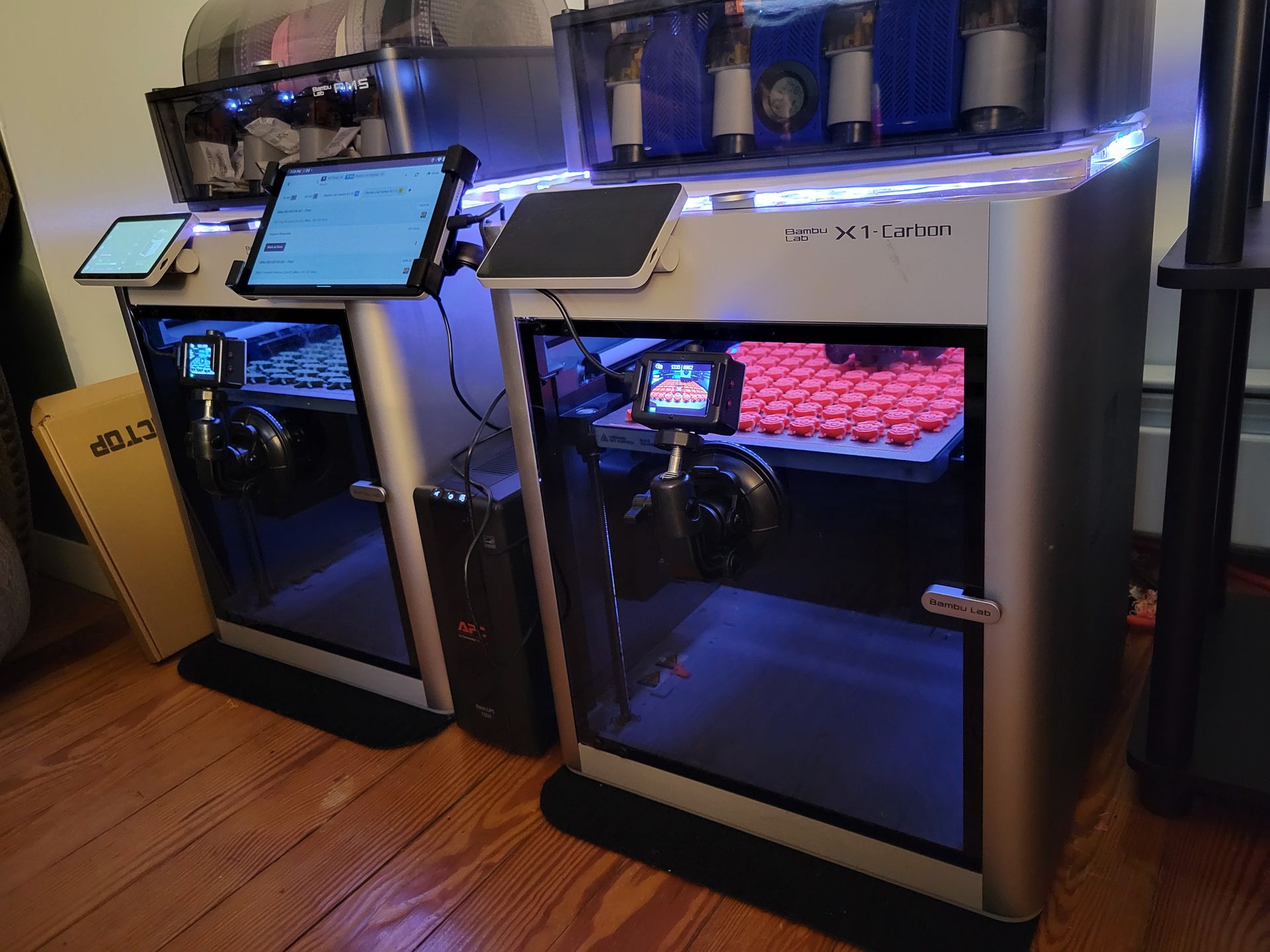
The Printing Process
- Designing: The process starts with creating a digital 3D model of the toy using specialized software. This model defines the shape, size, and details of the toy. While we have a few of our own original designs we license most of the designs we sell from other designers. We get to design the size, color(s), and quality we want to create.
- Slicing: The digital model is sliced into thin horizontal layers using slicing software. This slicing process generates instructions (G-code) for the 3D printer to follow.
- Printing: The sliced layers are sent to the 3D printer, which then begins the printing process. The printer heats up the filament material (we use PLA), melts it, and deposits it layer by layer according to the instructions in the G-clecode.
- Cooling: As each layer is deposited, it quickly cools and solidifies. This layer-by-layer approach gradually builds up the toy from the bottom up.
- Post-Processing: Once the printing is complete, the toy may require some post-processing. This can involve removing any support structures used during printing, sanding rough edges, and adding any finishing touches. At Mr. Spinner our products go through a special cleaning process to ensure the best finish.
- Quality Control: The finished toy is inspected for any defects or imperfections. Any necessary adjustments or corrections are made to ensure the toy meets quality standards. During this step at Mr. Spinner, we also test the product for strength and durability.
- Finished Toy: After post-processing and quality control checks, the toy is ready for use or packaging. It's now a fully realized 3D printed toy, ready to spark joy and imagination!
